Where to Mount Security Cameras on a Triple-Decker (and How Solar Holds Up in a Boston Winter)


If you live in or own a triple-decker, you already know these houses don't have just one front door. There's the main entry, three stacked porches, back stairs that run all the way up, a side alley or driveway, and a shared mailbox spot by the door. That's a lot of ways in, and most of them are out of sight from the street. A camera setup built for a ranch house or a single-family colonial leaves big gaps on a triple-decker. Here's how to cover one floor by floor, and how to keep solar-powered cameras running through a Boston winter.
Why triple-deckers need their own plan
Triple-deckers pack three households into a tall, narrow footprint, often with neighbors just a few feet away on each side. Packages pile up at the shared entry. Back stairs give anyone a quiet route to every unit. Side alleys are dark and narrow, which makes them easy to slip through. A single doorbell camera only sees a fraction of that. You get much better coverage by thinking about each entry point, not each floor.
Floor by floor: where to mount cameras
Front door and shared entry. This is where packages land and where visitors come and go. A camera here covers the mailbox and the main door at once. Mount it so it sees faces as people walk up, not just the tops of their heads.
Each front porch. Every unit's porch is its own entry, especially on the second and third floors where porch doors often lead straight into a kitchen or living room. One camera per porch, angled toward the door and the stairs leading up to it, gives each household its own view.
Back stairs and decks. This is the spot most people forget, and it's often the easiest way in. Back stairs connect every floor, sit out of view from the street, and are usually dim at night. A camera near the top of the stairs, looking down, sees anyone coming up.
Side alley or driveway. The narrow gap between houses is a natural shortcut and a hiding spot. A light makes a big difference here. Motion-activated light tends to send people the other way, and the camera records when they don't leave.
Height and angle. For most spots, mount cameras about 7 to 9 feet up and angle them slightly down. That's high enough to be hard to reach and low enough to capture faces clearly.
Our wire-free solar pick: the Reolink OMVI 2i Ultra
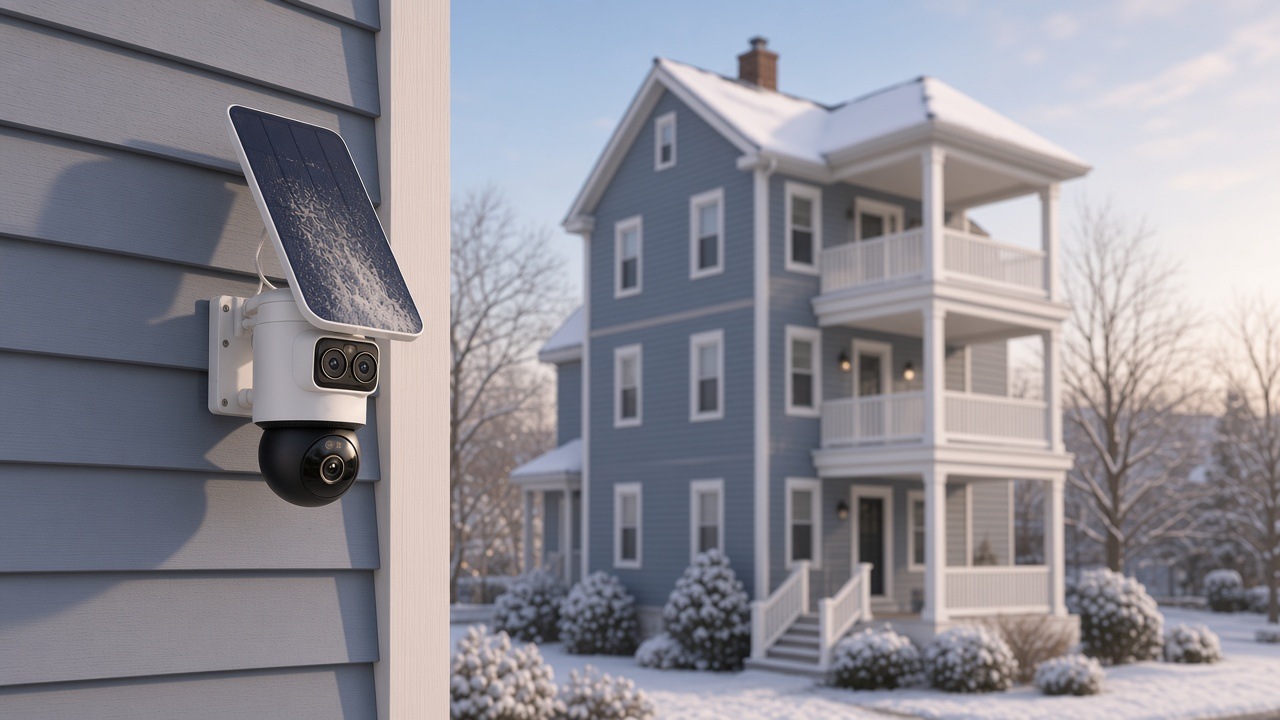
For porches and back stairs, our pick is the Reolink OMVI 2i Ultra ($229.99). It's wire-free with a built-in 6W solar panel, so you don't have to drill through siding or run power up three stories. It pairs a 4K wide view with pan-tilt tracking, so it can follow someone up the back stairs or across a porch instead of losing them at the edge of the frame. For a triple-decker, where outlets are rarely where you need them, that matters a lot.
Light up the alley: the Reolink Solar Floodlight Cam
For the side alley or driveway, the Reolink Solar Floodlight Cam ($119.99) does two jobs. It lights up the dark gap between houses when it senses motion, and it records what happens. It's also solar powered, so it works in the spots where no one ever ran an outdoor outlet.
Solar cameras in a Boston winter
Solar works here, but winter is the real test. Days are short, the sun sits low in the sky, and snow can bury a panel overnight. A few habits keep solar cameras charged all season:
- Face panels south. That's where the low winter sun spends most of the day.
- Tilt them steeply. A steeper angle catches more of the low winter sun, and snow slides off on its own.
- Watch for shade. Triple-deckers sit close together, so the house next door can block your panel for hours. Check where the shadow falls in the afternoon before you mount anything.
- Brush them off after a storm. A quick sweep after a snowfall gets the panel working again.
- Keep an eye on the battery in December and January. Those are the shortest days. If a camera is in a shady spot, cutting back on how often it records can help it last until spring.
Renting? Read this first
If you rent, ask your landlord before mounting anything, and check your lease. Wire-free cameras like the OMVI 2i Ultra are a good fit for renters. They need no wiring, mount with just a few screws, and come down when you move out. If you share a porch or entry with other tenants, it's courteous to let them know a camera is going up, and to point it at your own door and stairs rather than into a neighbor's windows.
Covering the whole house at once
If you'd rather outfit the whole house in one go, our Eufy Whole Home bundle (on sale for $564.99, was $709.99) puts together a HomeBase, a solar outdoor camera, a video doorbell, a smart lock and an indoor camera for less than buying them separately. A smaller Eufy Front Door starter is also available.
FAQ
Where should I mount security cameras on a triple-decker? Cover the shared entry, every porch, the back stairs and the alley. You get much better coverage by thinking about each entry point, not each floor.
How high should outdoor cameras be mounted? For most spots, mount cameras about 7 to 9 feet up and angle them slightly down. That's high enough to be hard to reach and low enough to capture faces clearly.
Do solar cameras work in a Boston winter? Solar works here, but winter is the real test. Days are short, the sun sits low in the sky, and snow can bury a panel overnight. Face panels south, tilt them steeply, watch for shade and brush them off after a storm.
Can I put up cameras if I rent? If you rent, ask your landlord before mounting anything, and check your lease. Wire-free cameras like the OMVI 2i Ultra are a good fit for renters. They need no wiring, mount with just a few screws, and come down when you move out.
The bottom line
A triple-decker has more ways in than most homes, and most of them are out of view from the street. Cover the shared entry, every porch, the back stairs and the alley. Mount cameras high and angled down. Set up solar panels for Boston's low winter sun and snow. Do that, and every household in the building gets a clear view of who's coming and going, all year round.
Shop wire-free solar cameras at securicocompany.com.